

What Does MMI Mean in Dayton, Ohio Workers’ Comp Claims?
Understanding Maximum Medical Improvement After a Dayton Work Injury
Key Takeaways: In Ohio workers’ compensation claims, maximum medical improvement (MMI) is the point where your treating physician determines your work-related condition has stabilized and no further significant improvement is expected, as defined under Ohio Admin. Code 4121-3-32(A)(1). Reaching MMI does not automatically end your care or close your claim, but it can serve as grounds to terminate temporary total disability (TTD) compensation and marks the shift toward permanent disability evaluation. Because MMI functions as the legal dividing line between temporary and permanent disability status, a worker generally cannot be found permanently and totally disabled until MMI is reached. An MMI finding can be established by a treating physician or adjudicated through a formal hearing, allowing injured workers to contest premature determinations, though compensation paid after the MMI date may be declared an overpayment if the finding is upheld. Objection deadlines are short, often within twenty days of a tentative BWC order, making prompt action essential to protecting your benefits.
Maximum medical improvement, or MMI, is the point in your recovery where your treating physician determines that your work-related condition has stabilized and no further significant medical improvement is expected, even with continued care. In Ohio workers’ compensation claims, this medical milestone carries major legal weight because it can change the type of benefits you receive. For injured workers in Dayton, understanding what MMI means is essential to protecting wage-replacement benefits and preparing for the next stage of a claim.
If you are recovering from a work injury and worried about what happens when your doctor mentions MMI, the team at Horenstein Nicholson & Blumenthal is ready to help. You can call our office directly at (937) 224-7200 or reach out through our online case review request to discuss your situation.
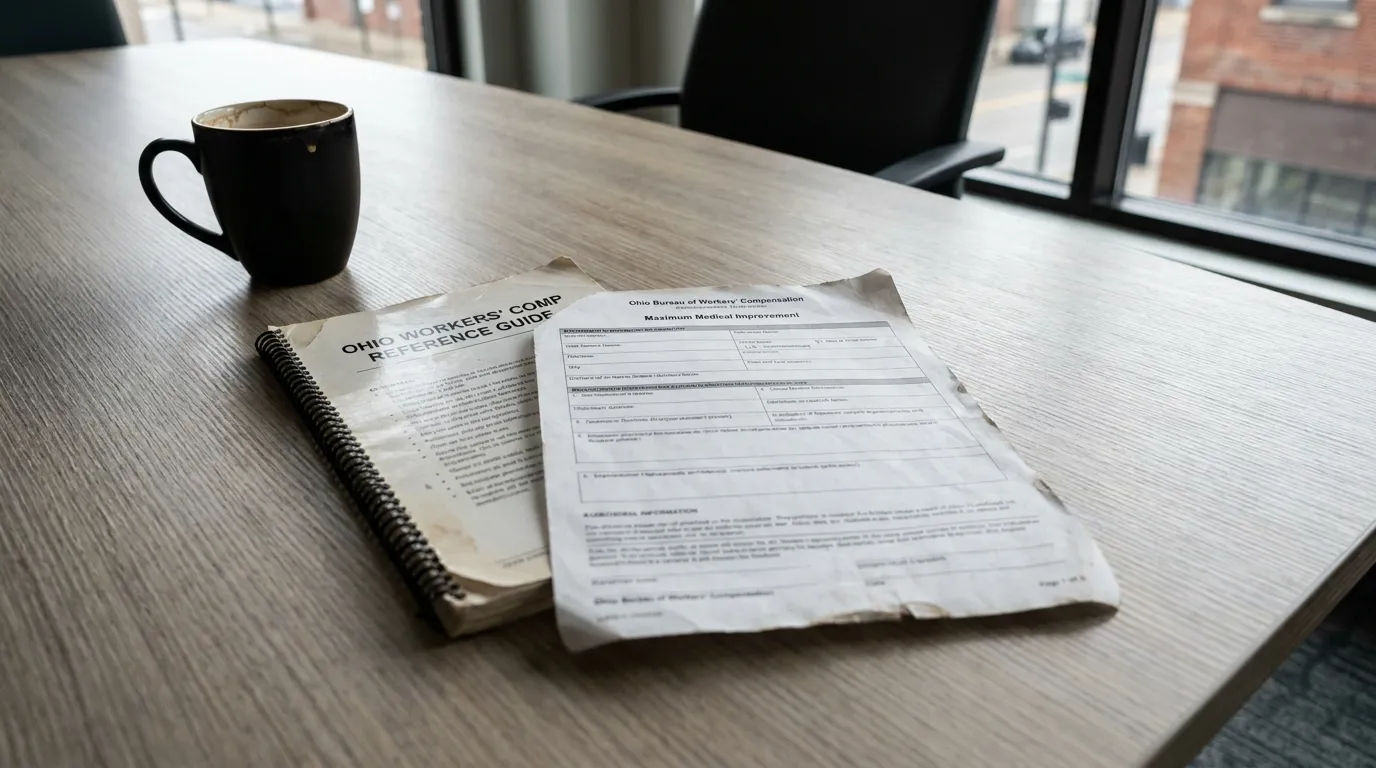
What Does MMI Mean in Workers Comp Under Ohio Law
The controlling legal definition of MMI comes directly from Ohio’s administrative code. Under Ohio Admin. Code 4121-3-32(A)(1), maximum medical improvement is defined as “a treatment plateau (static or well-stabilized) at which no fundamental functional or physiological change can be expected within reasonable medical probability in spite of continuing medical or rehabilitative procedures.” This standard governs MMI determinations in Dayton and throughout the state, focusing on whether meaningful recovery can still occur.
Reaching this plateau does not mean your medical treatment stops entirely. The same rule notes that “an injured worker may need supportive treatment to maintain this level of function.” In practice, you may continue to receive care designed to keep your condition stable, such as ongoing therapy, medication management, or periodic evaluations.
💡 Pro Tip: When a physician’s report mentions MMI, request a copy in writing and review the exact language used. The specific wording can affect whether an adjuster or hearing officer treats your condition as stabilized.
Where MMI Fits in the Ohio Statutory Framework
MMI operates within Ohio’s broader workers’ compensation statute, set out in the Ohio workers’ compensation statute found in Chapter 4123 of the Ohio Revised Code. Key provisions where MMI comes into play include R.C. 4123.56 governing temporary disability, R.C. 4123.57 governing partial disability, and R.C. 4123.58 governing permanent total disability. The administrative rule defining MMI amplifies R.C. 4123.56, tying the medical standard directly to the underlying statute.
How Reaching MMI Can End Temporary Total Disability
One of the most significant consequences of reaching MMI is that it can end your temporary total disability, or TTD, compensation. A treating physician’s MMI determination as a basis for stopping TTD payments is grounded in Ohio Revised Code Section 4123.56. This is why the timing and accuracy of an MMI finding are so important to your income during recovery.
A treating physician’s report is not the only way MMI can be established. Under Ohio Admin. Code 4121-3-32(B)(2)(c), TTD may also be terminated upon the finding of a district hearing officer, staff hearing officer, deputy, or the Industrial Commission that you have reached maximum medical improvement. MMI can be adjudicated in a formal proceeding rather than decided by a single doctor’s note. This gives injured workers an opportunity to contest a premature or disputed MMI determination, but it carries financial risk: under Ohio Admin. Code 4121-3-32, if a hearing officer finds you were no longer entitled to TTD as of the MMI date, compensation paid after that date can be declared an overpayment and recouped from future awards.
💡 Pro Tip: If your TTD benefits are terminated based on an MMI finding you disagree with, act quickly. Deadlines to object are short, and waiting can limit your options.
Common Challenges Injured Workers Face at MMI
Many Dayton workers encounter predictable problems when a claim reaches the MMI stage. Being aware of them can help you respond effectively.
- A sudden stop in wage-replacement benefits when TTD is terminated after an MMI finding.
- Confusion over whether ongoing supportive treatment is still covered.
- Disagreement between a treating physician and an examining physician retained by the BWC or commission.
- Uncertainty about how to transition from temporary benefits to a permanent disability evaluation.
Medical evidence drives nearly every one of these disputes. Ohio’s rules authorize procedures for oral depositions or written interrogatories of a physician who performed an examination on behalf of the BWC or commission, under rule 4121-3-09. This reflects how central medical opinions are once treatment stabilizes.
From Temporary to Permanent: MMI as the Dividing Line
In Ohio, MMI functions as the legal dividing line between temporary and permanent disability status. If your allowed condition has not reached maximum medical improvement, you generally cannot be found permanently and totally disabled. Ohio Admin. Code 4121-3-34(D)(1)(f) provides that if a hearing officer finds “the injured worker’s allowed medical condition(s) is temporary and has not reached maximum medical improvement, the injured worker shall be found not to be permanently and totally disabled because the condition(s) remains temporary.”
When a condition has not yet reached MMI, the claim is redirected toward temporary total disability rather than permanent benefits. Under Rule 4121-3-34(D)(1)(f), in state-fund claims the matter is “referred to the administrator to consider the issuance of an order on the question of entitlement to temporary total disability compensation,” while self-insuring employers are “notified to consider the question of the injured worker’s entitlement to temporary total disability compensation.”
| Claim Stage | General MMI Status | Typical Benefit Focus |
|---|---|---|
| Active treatment | Not yet at MMI | Temporary total disability (R.C. 4123.56) |
| Condition stabilized | MMI reached | Permanent partial or permanent total evaluation (R.C. 4123.57, 4123.58) |
| Post-MMI maintenance | At MMI with supportive care | Ongoing supportive treatment to maintain function |
Outcomes depend on the specific facts of each claim, and the categories above are general illustrations rather than guarantees.
What Happens to Your Claim After MMI
Once you reach MMI, your claim often moves toward a determination of permanent partial disability, or PPD. Under Rule 4121-3-15, both an application for determination of the percentage of permanent partial disability and an application for an increase are referred to as an “application.” This stage typically involves a physician examination to assess the degree of lasting impairment. The Industrial Commission also retains continuing jurisdiction, which R.C. 4123.84(C) describes as including “jurisdiction to award compensation or benefits for loss or impairment of bodily functions.”
💡 Pro Tip: Keep detailed records of any lasting limitations, pain, or reduced function after MMI. This documentation can support a permanent partial disability application.
Challenging or Preparing for an MMI Finding
You have defined procedural rights when the BWC issues a tentative order on a disability determination. Objections to a tentative BWC order under R.C. 4123.57 must generally be filed within twenty days of receipt, after which the matter is referred to the commission and set for hearing before a district hearing officer. Because these deadlines are short and applied strictly, prompt action is important.
A knowledgeable advocate can help you gather the medical evidence needed to contest a premature MMI determination. Whether you are documenting the work nexus of your injury or challenging an examining physician’s conclusion, a Dayton workers comp lawyer can help you present the strongest possible record. You can also learn more about your rights by reviewing resources on our Dayton workers compensation topics.
Frequently Asked Questions
1. Does reaching MMI mean my workers’ comp claim is over?
No, reaching MMI does not automatically close your claim. MMI generally marks a shift from temporary benefits toward a permanent disability evaluation, and you may still be entitled to permanent partial disability compensation. You may also continue to receive supportive treatment to maintain your level of function under Ohio Admin. Code 4121-3-32(A)(1).
2. Can my benefits stop the moment my doctor says I am at MMI?
In many cases, a treating physician’s MMI determination can serve as grounds to terminate temporary total disability under Ohio Revised Code Section 4123.56. However, MMI can be contested through a hearing. If the finding is upheld, compensation paid after the MMI date may be treated as an overpayment, so it is important to object and present medical evidence promptly.
3. What is the legal definition of maximum medical improvement in Ohio?
Ohio Admin. Code 4121-3-32(A)(1) defines MMI as a treatment plateau at which no fundamental functional or physiological change can be expected within reasonable medical probability, even with continuing care. You can review the full Ohio’s MMI definition rule for the exact language.
4. Can I be found permanently disabled before reaching MMI?
Generally, no. Under Ohio Admin. Code 4121-3-34(D)(1)(f), if your allowed condition is still temporary and has not reached maximum medical improvement, you cannot be found permanently and totally disabled. The claim is typically redirected toward temporary total disability compensation.
5. How long do I have to object to an MMI-related order?
Objections to a tentative BWC order under R.C. 4123.57 must generally be filed within twenty days of receipt. After that, the matter is referred to the commission and set for hearing before a district hearing officer.
Protecting Your Benefits at Every Stage of Recovery
Understanding what MMI means in workers’ comp gives Dayton workers a critical advantage in protecting their benefits. MMI is far more than a medical term, because under Ohio law it can end temporary total disability, mark the transition to permanent disability determinations, and shape the future of your entire claim. Since the standard is medical-evidence-driven and deadlines are short, being prepared and informed can make a meaningful difference.
If you are approaching MMI or facing a benefit termination after a work injury, the team at Horenstein Nicholson & Blumenthal is here to help you understand your options. Call us today at (937) 224-7200 or submit a confidential contact form to discuss how MMI may affect your Dayton workers’ compensation claim.
Related Posts

How to File a VSSR Application Within One Year of a Dayton Work Injury
Why Ohio’s Safety Violation Deadline Moves Faster Than Most Injured Workers Expect Key Takeaways: A VSSR (Violation of a Specific Safety Requirement) award is an additional payment of 15 to 50 percent of maximum weekly compensation, paid by the employer on top of regular Ohio workers’ compensation benefits. For injuries on or after September 15, 2020, H.B. 81 shortened the filing window to one year from…
READ MORE
What Is a Permanent Partial Disability Award for Dayton, Ohio Workers?
Understanding Compensation for Lasting Work Injuries in the Miami Valley Key Takeaways: A permanent partial disability (PPD) award in Ohio compensates a Dayton worker for a lasting, measurable impairment that does not completely prevent them from working. Governed by Chapter 4123 of the Ohio Revised Code, eligibility begins with being a covered employee, which includes most hourly and salaried workers. PPD awards are calculated from objective…
READ MORE
Who Proves Medical Causation in a Dayton Occupational Disease Claim?
Understanding the Burden of Proof in Ohio Occupational Disease Claims Key Takeaways: In a Dayton occupational disease claim, you must prove medical causation by connecting your diagnosis to your job through credible medical evidence. Your treating physician provides the primary causation opinion, often supported by industrial hygienists or toxicologists in complex exposure cases. Ohio’s no-fault system means you need not prove employer wrongdoing, but must show…
READ MORE
Should I Settle My Workers’ Comp Case in Dayton, Ohio?
Weighing a Workers’ Comp Settlement in the Miami Valley Key Takeaways: Whether you should settle your workers’ comp case in Dayton depends on your individual circumstances. In Ohio’s no-fault system, the key question is whether a lump sum fairly reflects your future medical needs, lost earning capacity, and potential disability awards, since settling generally closes the door on future benefits. Critical factors include reaching maximum medical…
READ MORE
What Is the Peculiar Risk Standard in a Dayton Disease Claim?
Understanding Disease Claims and the “Peculiar Risk” Concept in Ohio Key Takeaways: The peculiar risk standard in a Dayton disease claim asks whether your illness arose from a hazard distinctive to your job rather than a risk the general public faces, separating occupational diseases from ordinary illnesses under Ohio law. R.C. 4123.68 covers scheduled diseases like lead and mercury poisoning plus unlisted conditions meeting the statutory…
READ MORE
What Qualifies as an Occupational Disease Under Ohio Workers’ Comp Law?
Understanding Work-Related Illness in the Buckeye State Key Takeaways: Under Ohio workers’ comp law, an occupational disease is a condition contracted during employment that creates a hazard distinguishing your work from employment generally, meaning your job must expose you to greater risk than the public faces. Ohio uses a two-track approach: a statutory schedule under R.C. 4123.68 listing roughly 28 named diseases (including silicosis, asbestosis, coal…
READ MORE
What Rights Do Dayton Workers Have After a Job Injury in Ohio?
Understanding Your Rights After a Workplace Injury in Dayton Getting hurt on the job can turn your life upside down. If you work in one of Dayton’s manufacturing plants, warehouses, hospitals, or public-sector offices, you may be wondering what protections Ohio law provides. The good news is that Ohio operates a no-fault workers’ compensation system, which means you do not need to prove your employer was…
READ MOREGet HNB to Help You
What our client has to say

Laurie Ruscillo
in Google Reviews
“During a very difficult time, there was compassion and a truly dedicated effort from the staff for a favorable outcome with a disability claim from the Social Security Administration.”
Related Posts
How to File a VSSR Application Within One Year of a Dayton Work Injury
Why Ohio’s Safety Violation Deadline Moves Faster Than Most Injured Workers Expect Key Takeaways: A VSSR (Violation of a Specific Safety Requirement) award is an additional payment of 15 to 50 percent of maximum weekly compensation, paid by the employer on top of regular Ohio workers’ compensation benefits. For injuries on or after September 15, 2020, H.B. 81 shortened the filing window to one year from…
READ MORE What Is a Permanent Partial Disability Award for Dayton, Ohio Workers?
Understanding Compensation for Lasting Work Injuries in the Miami Valley Key Takeaways: A permanent partial disability (PPD) award in Ohio compensates a Dayton worker for a lasting, measurable impairment that does not completely prevent them from working. Governed by Chapter 4123 of the Ohio Revised Code, eligibility begins with being a covered employee, which includes most hourly and salaried workers. PPD awards are calculated from objective…
READ MORE Who Proves Medical Causation in a Dayton Occupational Disease Claim?
Understanding the Burden of Proof in Ohio Occupational Disease Claims Key Takeaways: In a Dayton occupational disease claim, you must prove medical causation by connecting your diagnosis to your job through credible medical evidence. Your treating physician provides the primary causation opinion, often supported by industrial hygienists or toxicologists in complex exposure cases. Ohio’s no-fault system means you need not prove employer wrongdoing, but must show…
READ MORE Should I Settle My Workers’ Comp Case in Dayton, Ohio?
Weighing a Workers’ Comp Settlement in the Miami Valley Key Takeaways: Whether you should settle your workers’ comp case in Dayton depends on your individual circumstances. In Ohio’s no-fault system, the key question is whether a lump sum fairly reflects your future medical needs, lost earning capacity, and potential disability awards, since settling generally closes the door on future benefits. Critical factors include reaching maximum medical…
READ MORE What Is the Peculiar Risk Standard in a Dayton Disease Claim?
Understanding Disease Claims and the “Peculiar Risk” Concept in Ohio Key Takeaways: The peculiar risk standard in a Dayton disease claim asks whether your illness arose from a hazard distinctive to your job rather than a risk the general public faces, separating occupational diseases from ordinary illnesses under Ohio law. R.C. 4123.68 covers scheduled diseases like lead and mercury poisoning plus unlisted conditions meeting the statutory…
READ MORE What Qualifies as an Occupational Disease Under Ohio Workers’ Comp Law?
Understanding Work-Related Illness in the Buckeye State Key Takeaways: Under Ohio workers’ comp law, an occupational disease is a condition contracted during employment that creates a hazard distinguishing your work from employment generally, meaning your job must expose you to greater risk than the public faces. Ohio uses a two-track approach: a statutory schedule under R.C. 4123.68 listing roughly 28 named diseases (including silicosis, asbestosis, coal…
READ MORE What Rights Do Dayton Workers Have After a Job Injury in Ohio?
Understanding Your Rights After a Workplace Injury in Dayton Getting hurt on the job can turn your life upside down. If you work in one of Dayton’s manufacturing plants, warehouses, hospitals, or public-sector offices, you may be wondering what protections Ohio law provides. The good news is that Ohio operates a no-fault workers’ compensation system, which means you do not need to prove your employer was…
READ MORE


Phone

Hours
AVAILABLE 24/7
OFFICES
Dayton, OH
220 E. Monument Ave.
Suite 305
Dayton, OH 45402