

What Is a Permanent Partial Disability Award for Dayton, Ohio Workers?
Understanding Compensation for Lasting Work Injuries in the Miami Valley
Key Takeaways: A permanent partial disability (PPD) award in Ohio compensates a Dayton worker for a lasting, measurable impairment that does not completely prevent them from working. Governed by Chapter 4123 of the Ohio Revised Code, eligibility begins with being a covered employee, which includes most hourly and salaried workers. PPD awards are calculated from objective medical evidence and clinical findings, typically after reaching maximum medical improvement. The process starts with filing a C-92 application, followed by a BWC tentative order that can be objected to within twenty days. Traditional injury claims must generally be filed within one year, and these filing requirements are jurisdictional. Workers may later seek an increased percentage with substantial evidence of new and changed circumstances.
A permanent partial disability award compensates an injured worker for a lasting impairment that does not completely prevent them from working. In Ohio, this benefit recognizes that a work injury can leave you with a measurable, permanent loss even after you return to work. For many Dayton employees in manufacturing, warehouse, healthcare, and transportation roles, a PPD award acknowledges an injury that will affect them long after initial recovery.
If you are trying to understand your rights after a lasting work injury, the team at Horenstein Nicholson & Blumenthal is ready to help. You can call our office at (937) 224-7200 to discuss your situation, or reach us through our online case review request to learn how these benefits may apply to you.
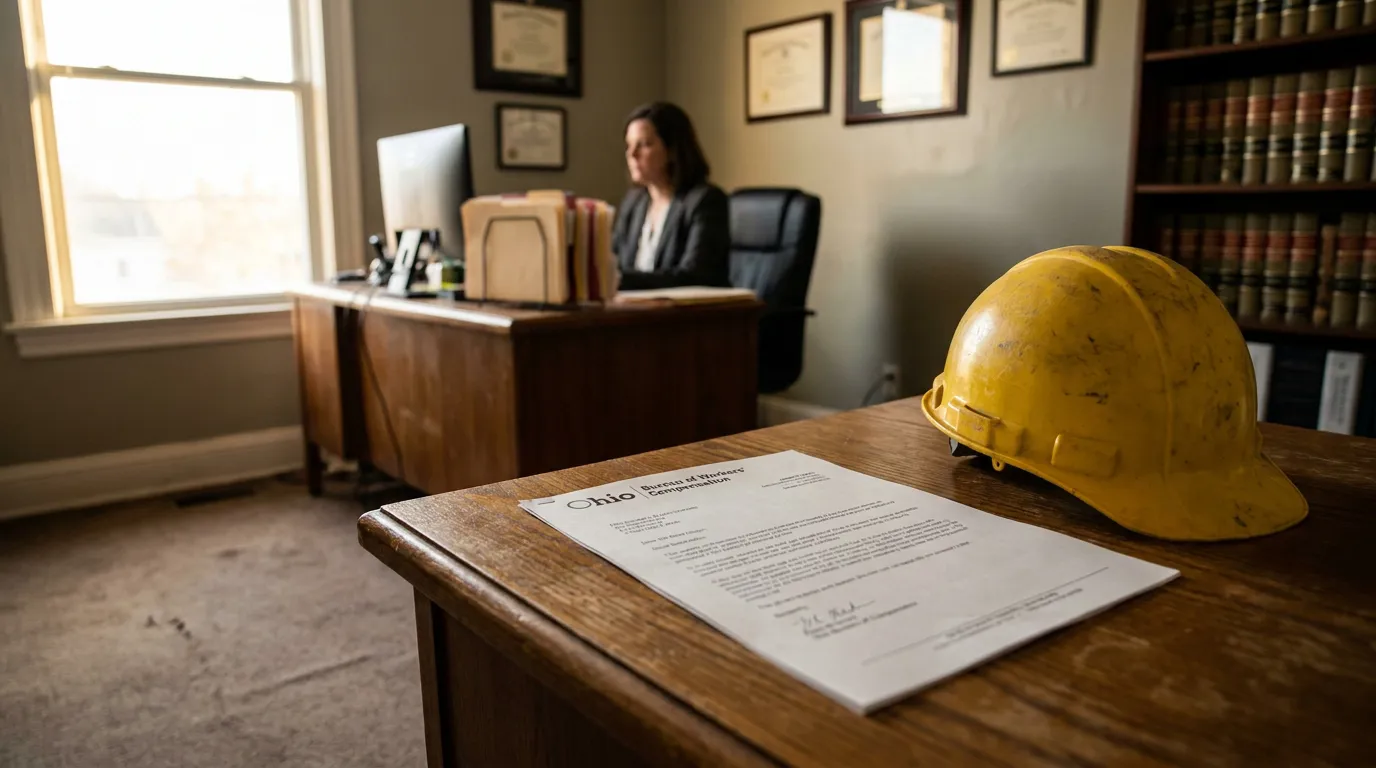
What a PPD Award Means Under Ohio Law
Ohio’s workers’ compensation system is built on statutory definitions that determine who can pursue benefits. Ohio’s workers’ compensation framework, including PPD awards, is governed by Chapter 4123 of the Ohio Revised Code. Section 4123.01 provides the definitional foundation, establishing who qualifies as an employee, employer, and self-insuring employer. Eligibility for a PPD award starts with being a covered worker.
The statute defines covered employment broadly, meaning most Dayton-area workers may qualify. Under the Ohio workers’ compensation definitions statute, coverage generally extends to persons employed under any contract of hire, express or implied, oral or written, including aliens and minors, along with certain household and casual workers who meet an earnings threshold. Hourly and salaried employees across many industries are potentially eligible for work injury benefits in Dayton, Ohio.
💡 Pro Tip: Keep copies of your pay records, job description, and any employment agreement. These documents can help confirm your status as a covered employee if the question ever arises during your claim.
How Ohio BWC Permanent Partial Disability Awards Are Calculated
Ohio BWC permanent partial disability awards are determined by objective medical evidence rather than subjective complaints. In the determination of percentage of permanent partial disability, hearing officers are to base the award on medical or clinical findings reasonably demonstrable. Your PPD impairment rating rests on documented, clinically supported findings rather than pain descriptions.
Benefit definitions and calculation formulas differ by state, so Ohio rules control here. A 50-state workers’ compensation overview explains that permanent partial disability benefits are often available according to a statutory schedule covering the loss or loss of use of various body parts. Ohio’s specific rules must be evaluated under Ohio law.
The general path from injury to a PPD determination follows these stages:
- Reporting the injury and filing a claim within the applicable deadline
- Receiving medical treatment and reaching maximum medical improvement
- Undergoing a medical exam that supports a percentage rating
- The BWC issuing a tentative order, followed by any objections and hearings
The C-92 Application and the Tentative Order Process
A worker generally starts the PPD process by filing an application, often called the C-92 application in Dayton and across Ohio. The BWC issues a tentative PPD order after a medical exam, and if a party objects within twenty days, the matter is referred to the Industrial Commission for hearing before a district hearing officer. The tentative order takes effect unless a timely objection is filed.
Ohio law recognizes disagreements between medical opinions and sets a specific threshold for challenging them. Ohio defines a substantial disparity in PPD medical opinions as a difference of fifteen per cent or more, which may entitle a party to depose or submit interrogatories to the examining physician. This gives injured workers a structured way to question inconsistent findings.
💡 Pro Tip: Read every BWC order carefully and note the date you received it. The right to object is tied to short timeframes, and missing a deadline can limit your options.
Appealing a PPD Decision You Disagree With
If you are unhappy with a district hearing officer’s decision, Ohio provides a path for reconsideration. A worker dissatisfied with a district hearing officer’s PPD decision may seek reconsideration by a staff hearing officer within ten days of receipt of the decision, and the staff hearing officer’s decision on reconsideration is final. A subsequent application to increase the percentage of permanent partial disability requires substantial evidence of new and changed circumstances developing since the time of the hearing on the original or last determination. This appeal structure is administrative and generally separate from civil court.
Ohio also allows workers to revisit the percentage of disability when their condition worsens. Under the administrative rule governing PPD procedures, Ohio law permits an application for an increase in the percentage, generally requiring substantial evidence of new and changed circumstances. If your impairment progresses over time, this may allow you to seek an adjustment.
| Stage | General Timeframe | Who Decides |
|---|---|---|
| Objection to tentative order | Within 20 days of receipt | Referred to Industrial Commission |
| Initial PPD hearing | After referral | District hearing officer |
| Reconsideration | Within 10 days of receipt | Staff hearing officer (final) |
The times above reflect general statutory and rule-based principles and can be affected by the specific facts of your claim.
Deadlines That Can Make or Break a PPD Claim
Filing deadlines are among the most important issues in any Dayton, Ohio work injury matter. Effective October 1, 2017, the statute of limitations for traditional injury or death claims was reduced from two years to one year, while occupational disease claims retain a two-year window. Prompt action is critical to preserving your right to any eventual award.
The filing requirement is not a formality, and Ohio courts treat it seriously. The claim-filing time limit statute requires written or facsimile notice of the specific part or parts of the body claimed injured to the Industrial Commission or Bureau of Workers’ Compensation. Ohio courts have described this requirement as jurisdictional, and it can be tolled only as expressly provided. Exceptions to filing deadlines are interpreted narrowly.
There is, however, an important feature that helps workers whose injuries evolve. The Industrial Commission retains continuing jurisdiction over a validly filed claim, allowing compensation or benefits to be awarded for later-developing impairment in body parts not originally specified, provided they flow from the original injury. This matters because PPD awards are frequently determined well after the initial injury.
💡 Pro Tip: Report your injury to your employer as soon as possible and identify every affected body part in writing. The deadline for reporting the injury is often shorter than the deadline for filing a claim, and reporting is part of the process of starting a claim.
Practical Guidance for Dayton Workers Pursuing PPD
Understanding the process is easier when you know where the common pitfalls lie. Many injured workers underestimate how much a PPD award depends on thorough medical documentation, and gaps in your records can weaken your position. Building a clear, medically supported file early can help support a fair percentage.
Knowing your rights is a strong first step, but the details are fact-specific. For more general guidance on Ohio claims, our workers’ compensation resource articles cover related topics for injured employees. Outcomes depend on specific facts, medical evidence, and how applicable rules are applied.
Frequently Asked Questions
1. What is the difference between PPD and permanent total disability?
Both are disability benefit categories, but they address different levels of loss. A PPD award compensates a lasting impairment that does not fully prevent work, while permanent total disability addresses a more complete loss of earning capacity.
2. How is my PPD percentage decided?
Your percentage is based on objective medical evidence. Hearing officers rely on medical or clinical findings that are reasonably demonstrable, not subjective descriptions alone. Detailed and consistent medical records are crucial.
3. Can I increase my PPD award later?
In many cases, yes, but only under certain conditions. An application to increase the percentage requires substantial evidence of new and changed circumstances. If your condition worsens, this may provide a path to seek adjustment.
4. What happens if I miss the filing deadline?
Missing the deadline can be serious because the filing requirement is jurisdictional. Ohio courts allow tolling only as expressly provided, and exceptions are interpreted narrowly. Acting promptly is the safest approach.
5. Do I have to accept the BWC’s tentative order?
No. If you disagree, you may object within the applicable window, which refers the matter for a hearing. A knowledgeable Dayton workers comp attorney can help evaluate whether an objection is appropriate.
Protecting Your Right to a Fair Award
A permanent partial disability award recognizes the lasting impact a workplace injury can have on your body and your livelihood. From the definitions in Section 4123.01 to the calculation standards and appeal rights, Ohio BWC permanent partial disability awards follow a structured process that rewards prompt reporting and strong medical evidence. Because deadlines are short and exceptions are limited, understanding your rights early can make a meaningful difference. For personalized guidance, it helps to work with a trusted Ohio BWC permanent partial disability awards lawyer who understands how these rules apply in the Miami Valley.
If you have suffered a lasting work injury, the attorneys at Horenstein Nicholson & Blumenthal are ready to review your claim and explain your options. Call our Dayton office at (937) 224-7200 or request your consultation online to take the next step toward protecting your workers’ compensation rights.
Related Posts

How to File a VSSR Application Within One Year of a Dayton Work Injury
Why Ohio’s Safety Violation Deadline Moves Faster Than Most Injured Workers Expect Key Takeaways: A VSSR (Violation of a Specific Safety Requirement) award is an additional payment of 15 to 50 percent of maximum weekly compensation, paid by the employer on top of regular Ohio workers’ compensation benefits. For injuries on or after September 15, 2020, H.B. 81 shortened the filing window to one year from…
READ MORE
What Does MMI Mean in Dayton, Ohio Workers’ Comp Claims?
Understanding Maximum Medical Improvement After a Dayton Work Injury Key Takeaways: In Ohio workers’ compensation claims, maximum medical improvement (MMI) is the point where your treating physician determines your work-related condition has stabilized and no further significant improvement is expected, as defined under Ohio Admin. Code 4121-3-32(A)(1). Reaching MMI does not automatically end your care or close your claim, but it can serve as grounds to…
READ MORE
Who Proves Medical Causation in a Dayton Occupational Disease Claim?
Understanding the Burden of Proof in Ohio Occupational Disease Claims Key Takeaways: In a Dayton occupational disease claim, you must prove medical causation by connecting your diagnosis to your job through credible medical evidence. Your treating physician provides the primary causation opinion, often supported by industrial hygienists or toxicologists in complex exposure cases. Ohio’s no-fault system means you need not prove employer wrongdoing, but must show…
READ MORE
Should I Settle My Workers’ Comp Case in Dayton, Ohio?
Weighing a Workers’ Comp Settlement in the Miami Valley Key Takeaways: Whether you should settle your workers’ comp case in Dayton depends on your individual circumstances. In Ohio’s no-fault system, the key question is whether a lump sum fairly reflects your future medical needs, lost earning capacity, and potential disability awards, since settling generally closes the door on future benefits. Critical factors include reaching maximum medical…
READ MORE
What Is the Peculiar Risk Standard in a Dayton Disease Claim?
Understanding Disease Claims and the “Peculiar Risk” Concept in Ohio Key Takeaways: The peculiar risk standard in a Dayton disease claim asks whether your illness arose from a hazard distinctive to your job rather than a risk the general public faces, separating occupational diseases from ordinary illnesses under Ohio law. R.C. 4123.68 covers scheduled diseases like lead and mercury poisoning plus unlisted conditions meeting the statutory…
READ MORE
What Qualifies as an Occupational Disease Under Ohio Workers’ Comp Law?
Understanding Work-Related Illness in the Buckeye State Key Takeaways: Under Ohio workers’ comp law, an occupational disease is a condition contracted during employment that creates a hazard distinguishing your work from employment generally, meaning your job must expose you to greater risk than the public faces. Ohio uses a two-track approach: a statutory schedule under R.C. 4123.68 listing roughly 28 named diseases (including silicosis, asbestosis, coal…
READ MORE
What Rights Do Dayton Workers Have After a Job Injury in Ohio?
Understanding Your Rights After a Workplace Injury in Dayton Getting hurt on the job can turn your life upside down. If you work in one of Dayton’s manufacturing plants, warehouses, hospitals, or public-sector offices, you may be wondering what protections Ohio law provides. The good news is that Ohio operates a no-fault workers’ compensation system, which means you do not need to prove your employer was…
READ MOREGet HNB to Help You
What our client has to say

Laurie Ruscillo
in Google Reviews
“During a very difficult time, there was compassion and a truly dedicated effort from the staff for a favorable outcome with a disability claim from the Social Security Administration.”
Related Posts
How to File a VSSR Application Within One Year of a Dayton Work Injury
Why Ohio’s Safety Violation Deadline Moves Faster Than Most Injured Workers Expect Key Takeaways: A VSSR (Violation of a Specific Safety Requirement) award is an additional payment of 15 to 50 percent of maximum weekly compensation, paid by the employer on top of regular Ohio workers’ compensation benefits. For injuries on or after September 15, 2020, H.B. 81 shortened the filing window to one year from…
READ MORE What Does MMI Mean in Dayton, Ohio Workers’ Comp Claims?
Understanding Maximum Medical Improvement After a Dayton Work Injury Key Takeaways: In Ohio workers’ compensation claims, maximum medical improvement (MMI) is the point where your treating physician determines your work-related condition has stabilized and no further significant improvement is expected, as defined under Ohio Admin. Code 4121-3-32(A)(1). Reaching MMI does not automatically end your care or close your claim, but it can serve as grounds to…
READ MORE Who Proves Medical Causation in a Dayton Occupational Disease Claim?
Understanding the Burden of Proof in Ohio Occupational Disease Claims Key Takeaways: In a Dayton occupational disease claim, you must prove medical causation by connecting your diagnosis to your job through credible medical evidence. Your treating physician provides the primary causation opinion, often supported by industrial hygienists or toxicologists in complex exposure cases. Ohio’s no-fault system means you need not prove employer wrongdoing, but must show…
READ MORE Should I Settle My Workers’ Comp Case in Dayton, Ohio?
Weighing a Workers’ Comp Settlement in the Miami Valley Key Takeaways: Whether you should settle your workers’ comp case in Dayton depends on your individual circumstances. In Ohio’s no-fault system, the key question is whether a lump sum fairly reflects your future medical needs, lost earning capacity, and potential disability awards, since settling generally closes the door on future benefits. Critical factors include reaching maximum medical…
READ MORE What Is the Peculiar Risk Standard in a Dayton Disease Claim?
Understanding Disease Claims and the “Peculiar Risk” Concept in Ohio Key Takeaways: The peculiar risk standard in a Dayton disease claim asks whether your illness arose from a hazard distinctive to your job rather than a risk the general public faces, separating occupational diseases from ordinary illnesses under Ohio law. R.C. 4123.68 covers scheduled diseases like lead and mercury poisoning plus unlisted conditions meeting the statutory…
READ MORE What Qualifies as an Occupational Disease Under Ohio Workers’ Comp Law?
Understanding Work-Related Illness in the Buckeye State Key Takeaways: Under Ohio workers’ comp law, an occupational disease is a condition contracted during employment that creates a hazard distinguishing your work from employment generally, meaning your job must expose you to greater risk than the public faces. Ohio uses a two-track approach: a statutory schedule under R.C. 4123.68 listing roughly 28 named diseases (including silicosis, asbestosis, coal…
READ MORE What Rights Do Dayton Workers Have After a Job Injury in Ohio?
Understanding Your Rights After a Workplace Injury in Dayton Getting hurt on the job can turn your life upside down. If you work in one of Dayton’s manufacturing plants, warehouses, hospitals, or public-sector offices, you may be wondering what protections Ohio law provides. The good news is that Ohio operates a no-fault workers’ compensation system, which means you do not need to prove your employer was…
READ MORE


Phone

Hours
AVAILABLE 24/7
OFFICES
Dayton, OH
220 E. Monument Ave.
Suite 305
Dayton, OH 45402