

Should Dayton Drivers Move a Car After a Minor Ohio Collision?
The Short Answer for Dayton Drivers Facing a Fender Bender
Key Takeaways: Dayton drivers can move a car after a minor Ohio collision, but only after fulfilling their legal duties first. Ohio law requires you to stop immediately, remain at the scene, and exchange identifying information including name, address, and vehicle registration before repositioning any vehicle. Once you’ve met those duties and documented the original positions with photos, moving a drivable car to a safer spot is often reasonable. Special rules apply to parked cars and private property, where you must leave written information or report to police within 24 hours if in-person exchange is impossible. Failing to follow these duties can turn an insurance matter into a criminal charge, ranging from a first-degree misdemeanor to a felony depending on the harm involved. Following the sequence, stop, stay, exchange, document, then move, protects both your safety and any future injury claim.
Moving your car after a minor Ohio collision is sometimes permissible, but only after you meet your legal duties at the scene. Ohio law requires you to stop, stay, and exchange information before repositioning a vehicle. Knowing this order is the difference between a routine insurance exchange and a criminal charge, especially for anyone dealing with a Dayton fender bender in a busy intersection or parking lot.
If you were injured by another driver and are unsure how to protect your claim, the team at Horenstein Nicholson & Blumenthal can help you understand your options. Call our office at (937) 224-7200 or reach out through our online case review request to discuss what happened.
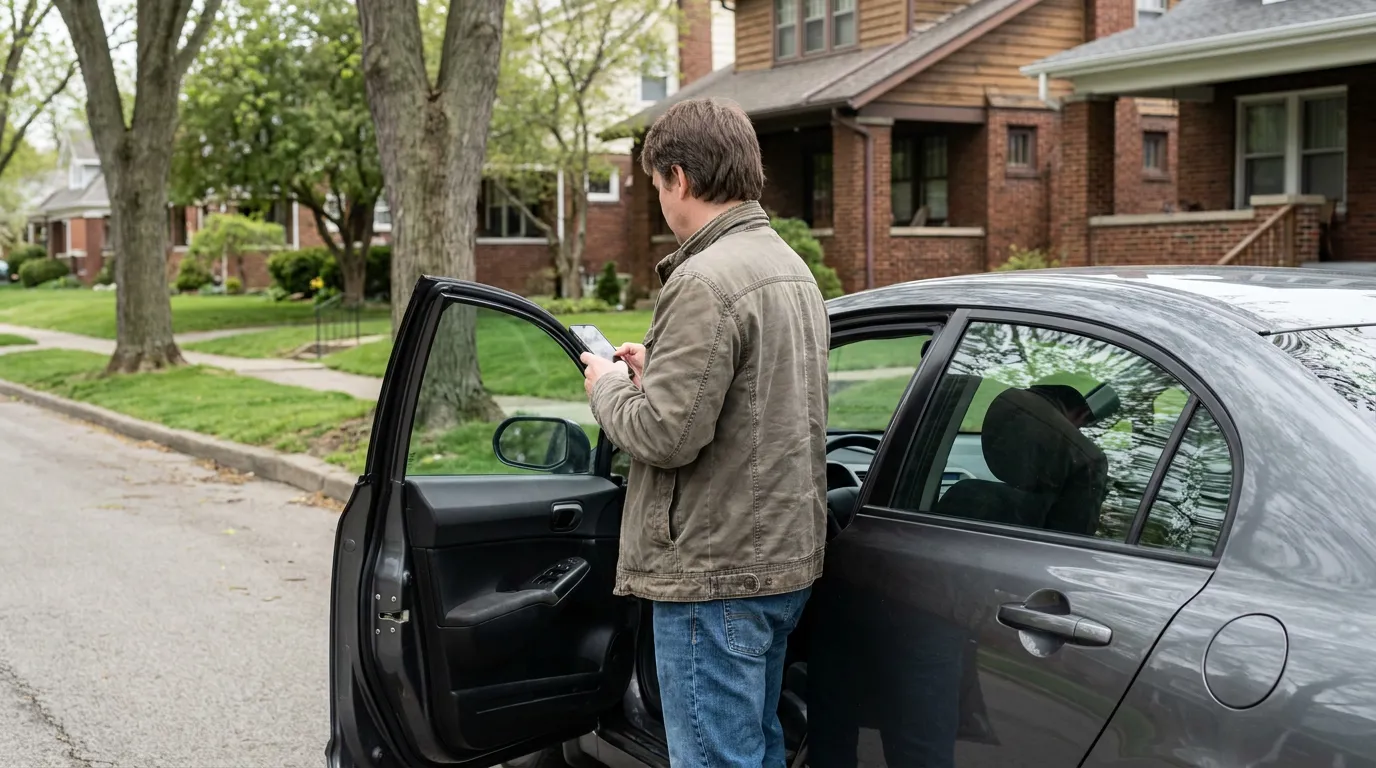
Why Ohio Requires You to Stop and Stay First
Before you touch the gearshift, Ohio requires you to stop your vehicle at the scene of any crash you know about. This obligation applies even when damage looks cosmetic and everyone feels fine. Under the statute, the operator must immediately stop at the scene. Stopping is not optional courtesy; it is a threshold legal duty.
Stopping alone is not enough. The driver must remain at the scene and exchange identifying information such as name, address, and vehicle registration with anyone injured, the other vehicle’s operator or owner, or a police officer. Repositioning a car for safety should never interfere with these duties. You can read the full text of Ohio’s stop-and-remain requirements to see exactly how the legislature framed these obligations.
The Information You Are Required to Share
The exchange of information is specific and defined by statute. After stopping, the driver must exchange identifying information including name, address, the vehicle owner’s name and address, the registration number, and, if available, show a driver’s license when requested. Providing partial details may not satisfy the requirement.
💡 Pro Tip: Photograph the other driver’s license, insurance card, and license plate with your phone rather than copying details by hand. This reduces transcription errors that insurers sometimes exploit later.
What to Do After a Car Accident in Ohio: On-Scene Steps
Knowing what to do after a car accident in Ohio starts with a predictable sequence you can follow even when adrenaline is high. The law and practical safety concerns generally point in the same direction: secure the scene, meet your statutory duties, then document everything.
Here is a practical order of on-scene accident steps for a minor collision in Ohio:
- Stop immediately and turn on your hazard lights.
- Check yourself and others for injuries and call 911 if anyone is hurt.
- Exchange the identifying information the statute requires.
- Photograph vehicle positions, damage, and road conditions before moving anything.
- Report the crash to law enforcement when required, and cooperate with the responding officer.
Documenting the scene is a widely recommended first step after any Ohio crash. Guidance for drivers advises taking pictures from all angles of your vehicle and the other vehicle involved, and noting weather and other variables. These images establish how a minor collision actually caused vehicle damage or injury, supporting the causation element that every negligence claim depends on.
💡 Pro Tip: Capture wide shots showing the full intersection or lot, then close-ups of each point of contact. The context photos often matter more than the damage photos when liability is disputed.
When Moving Your Car Is Reasonable
Once you have stopped, stayed, and exchanged information, moving your car to a safer position is often reasonable and sometimes advisable. Ohio’s traffic laws focus on the duty to stop and exchange information, not on freezing a vehicle in a dangerous location indefinitely. If a car sits in a live lane on a Dayton street, moving it to the shoulder after documenting the scene can prevent a secondary crash. The timing matters: documentation and information exchange should generally come first.
If vehicles are drivable and no one is seriously injured, relocating to a nearby lot or shoulder is generally acceptable once you have photographed the original positions. When damage is severe or anyone is hurt, it is usually better to leave vehicles in place and let officers document the scene.
💡 Pro Tip: If you must move a vehicle before police arrive, mark the tire positions with chalk or take a quick video panning across the scene. This preserves the pre-move layout for adjusters and investigators.
Special Rules for Parked Cars and Private Property
Collisions with unoccupied vehicles and crashes off public roads carry their own distinct duties under Ohio law. These situations are common in Dayton parking lots and private driveways, where a driver may be tempted to simply drive off. That temptation can lead directly to criminal exposure.
Hitting an Unoccupied or Parked Vehicle
When you strike a parked or unattended car, you cannot simply leave a note in your head and drive away. For collisions with an unoccupied vehicle, the driver must securely attach the required information in writing in a conspicuous place on that vehicle. The obligation to leave written contact details is a legal requirement, not a courtesy. Failure to comply could result in a charge for leaving the scene of an accident.
Crashes on Private Property
Ohio also imposes duties when a crash causes injury or damage on property other than a public road. The law requires a driver involved in a collision that causes injury or damage on private property to stop at the scene, provided they have knowledge of the accident. The statute governing these off-road and private-property duties is set out in Ohio’s private-property crash provisions.
The 24-Hour Reporting Window
When you genuinely cannot provide required information at the scene, Ohio gives a limited reporting window. If the driver cannot provide required information at the scene, they have 24 hours to report it to the local police department, or to the county sheriff if the crash occurred outside city or village limits. This window is narrow and should not be treated as a reason to leave when in-person exchange is possible.
The Legal Risk of Getting It Wrong
Mishandling even a small crash can convert an insurance matter into a criminal case. Failing to comply with the stop-and-exchange duty constitutes the crime of failure to stop after an accident, generally a first-degree misdemeanor for minor incidents. The consequences escalate with the severity of harm involved.
| Situation | General Classification |
|---|---|
| Minor crash, no serious harm | First-degree misdemeanor |
| Crash causing serious physical harm | Felony (up to fourth or fifth degree) |
| Crash resulting in death | Felony (up to second or third degree) |
For a non-public road accident, failing to stop is generally a first-degree misdemeanor, but escalates to a felony, up to a fourth-degree felony if serious physical harm results, and up to a second-degree felony if death results, along with a mandatory class five license suspension.
Insurers add another layer of pressure that makes careful documentation worthwhile. Insurance companies are known for downplaying the extent of injuries and damages after an accident. Thorough scene records help counter that tactic. For a broader library of accident guidance, you can browse our Dayton injury law articles for related topics.
💡 Pro Tip: Save your medical records and mileage logs from day one. Insurers frequently argue that a gap between the crash and treatment means an injury was unrelated.
Frequently Asked Questions
1. Can I move my car after a minor collision in Ohio?
Generally yes, but only after meeting your duties. You must first stop, remain at the scene, and exchange information. Moving a drivable vehicle to a safer spot is often reasonable once you have documented the original positions.
2. What if I hit a parked car and no one is around?
You must leave your information in writing on the vehicle. If the collision involves an unoccupied vehicle, the driver must securely attach the required information in writing to that vehicle. Driving off can support a leaving-the-scene charge.
3. Should I see a doctor after a minor fender bender?
A medical evaluation is generally advisable even when you feel fine. Even in minor collisions, seeking medical evaluation ensures injuries can be traced back to the accident. Delayed-onset symptoms are common after low-speed crashes.
4. How long do I have to file a car accident claim in Ohio?
Ohio applies a two-year civil deadline in most cases. According to the Ohio Statute of Limitations, you generally have two years from the date of the accident to file a claim. Courts interpret exceptions narrowly, and they do not apply automatically, so timely action matters.
5. What information must I exchange at the scene?
You must share statutory identifying details. Under Ohio law, a driver involved in an accident must remain at the scene until they have given their name and address together with the registered number of that motor vehicle to the operator or owner of any motor vehicle damaged.
Handling a Dayton Crash the Right Way
The safest approach to a minor collision in Ohio is to treat your on-scene duties as non-negotiable and moving your car as a secondary step. Stop, stay, exchange information, and document the scene before you reposition anything. These habits protect both your safety and any future claim against an at-fault driver, and they keep a routine Dayton car accident from becoming a criminal or coverage problem.
If another driver’s negligence left you injured, guidance from an experienced Dayton auto accident attorney can help you preserve evidence and pursue fair compensation. Contact Horenstein Nicholson & Blumenthal by calling (937) 224-7200, visiting our main website, or submitting a request through our confidential contact form to have your questions answered.
Related Posts

What Is Substantial Aggravation of a Pre-Existing Condition in Ohio?
When a Work Injury Makes an Old Problem Much Worse Key Takeaways: In Ohio, a substantial aggravation of a pre-existing condition occurs when a work injury meaningfully worsens an existing health problem, compensable under R.C. § 4123.01(C)(4) only when documented by objective diagnostic findings, objective clinical findings, or objective test results, not subjective pain complaints alone. Ohio’s no-fault system means having a bad back, arthritic joints,…
READ MORE
What Is an MCS-90 Endorsement in a Dayton Truck Accident Claim?
How the MCS-90 Endorsement Truck Accident Protection Actually Works The endorsement is a promise made to the public, not just to the insured carrier. Under 49 CFR 387.15, the insurer agrees to pay any final judgment recovered against the insured for public liability arising from negligent operation of motor vehicles, up to the applicable minimum limit. Because the obligation runs to the public, courts have held…
READ MORE
What Is the No-Zone Around Trucks in Dayton, Ohio?
Understanding the Hidden Danger of Truck Blind Spots on Dayton Roads Key Takeaways: The no-zone is the set of blind spot areas at the front, back, and both sides of a large truck where a smaller vehicle disappears from the driver’s view, creating a core hazard on Dayton roads like I-75 and U.S. 35. The right side is the largest blind spot and the rear leaves…
READ MOREWhat Is a Hit and Run Injury Claim Under Ohio Law for Dayton Victims?
Understanding Your Rights After a Hit-Skip Crash in the Miami Valley Key Takeaways: A hit and run injury claim under Ohio law allows Dayton victims to seek compensation after a driver flees, primarily through their own uninsured motorist (UM) coverage, since Ohio treats a fleeing driver like an uninsured one. Recovery remains possible even when the driver is never identified, provided independent corroborating evidence such as…
READ MORE
What Should Dayton Workers Weigh Before Accepting a Lump Sum Settlement?
Understanding Lump Sum Settlements in Ohio’s Workers’ Comp System Key Takeaways: Before accepting a lump sum settlement (LSS), Dayton workers should weigh immediate financial relief against long-term rights they may permanently give up. An LSS closes all or part of a claim for a one-time payment often discounted to present value. Either party can initiate a settlement under Ohio law, so an employer’s offer may reflect…
READ MORE
What Makes a Dayton Truck Accident Case Harder to Prove Than a Car Crash?
Why Trucking Claims Demand a Different Playbook Than Ordinary Crashes Key Takeaways: A Dayton truck accident case is harder to prove than a car crash because liability can be spread across multiple parties, the driver, carrier, maintenance provider, and cargo loaders, each with separate insurance and defense counsel. Evidence is more technical, requiring driver logs, hours-of-service data, maintenance records, and black box downloads held by trucking…
READ MORE
How to Protect a Dayton Car Accident Claim From Adjuster Tactics
Why Dayton Drivers Lose Value on Otherwise Strong Claims Key Takeaways: Insurance adjusters minimize payouts using predictable tactics like delays, lowball offers, recorded statements, and inflated fault arguments. To protect a Dayton car accident claim, know what to do after a crash in Ohio before signing anything or giving a statement. Document the scene, seek prompt medical care, and preserve all evidence. Understand Ohio’s modified comparative…
READ MOREGet HNB to Help You
What our client has to say

Laurie Ruscillo
in Google Reviews
“During a very difficult time, there was compassion and a truly dedicated effort from the staff for a favorable outcome with a disability claim from the Social Security Administration.”
Related Posts
What Is Substantial Aggravation of a Pre-Existing Condition in Ohio?
When a Work Injury Makes an Old Problem Much Worse Key Takeaways: In Ohio, a substantial aggravation of a pre-existing condition occurs when a work injury meaningfully worsens an existing health problem, compensable under R.C. § 4123.01(C)(4) only when documented by objective diagnostic findings, objective clinical findings, or objective test results, not subjective pain complaints alone. Ohio’s no-fault system means having a bad back, arthritic joints,…
READ MORE What Is an MCS-90 Endorsement in a Dayton Truck Accident Claim?
How the MCS-90 Endorsement Truck Accident Protection Actually Works The endorsement is a promise made to the public, not just to the insured carrier. Under 49 CFR 387.15, the insurer agrees to pay any final judgment recovered against the insured for public liability arising from negligent operation of motor vehicles, up to the applicable minimum limit. Because the obligation runs to the public, courts have held…
READ MORE What Is the No-Zone Around Trucks in Dayton, Ohio?
Understanding the Hidden Danger of Truck Blind Spots on Dayton Roads Key Takeaways: The no-zone is the set of blind spot areas at the front, back, and both sides of a large truck where a smaller vehicle disappears from the driver’s view, creating a core hazard on Dayton roads like I-75 and U.S. 35. The right side is the largest blind spot and the rear leaves…
READ MOREWhat Is a Hit and Run Injury Claim Under Ohio Law for Dayton Victims?
Understanding Your Rights After a Hit-Skip Crash in the Miami Valley Key Takeaways: A hit and run injury claim under Ohio law allows Dayton victims to seek compensation after a driver flees, primarily through their own uninsured motorist (UM) coverage, since Ohio treats a fleeing driver like an uninsured one. Recovery remains possible even when the driver is never identified, provided independent corroborating evidence such as…
READ MORE What Should Dayton Workers Weigh Before Accepting a Lump Sum Settlement?
Understanding Lump Sum Settlements in Ohio’s Workers’ Comp System Key Takeaways: Before accepting a lump sum settlement (LSS), Dayton workers should weigh immediate financial relief against long-term rights they may permanently give up. An LSS closes all or part of a claim for a one-time payment often discounted to present value. Either party can initiate a settlement under Ohio law, so an employer’s offer may reflect…
READ MORE What Makes a Dayton Truck Accident Case Harder to Prove Than a Car Crash?
Why Trucking Claims Demand a Different Playbook Than Ordinary Crashes Key Takeaways: A Dayton truck accident case is harder to prove than a car crash because liability can be spread across multiple parties, the driver, carrier, maintenance provider, and cargo loaders, each with separate insurance and defense counsel. Evidence is more technical, requiring driver logs, hours-of-service data, maintenance records, and black box downloads held by trucking…
READ MORE How to Protect a Dayton Car Accident Claim From Adjuster Tactics
Why Dayton Drivers Lose Value on Otherwise Strong Claims Key Takeaways: Insurance adjusters minimize payouts using predictable tactics like delays, lowball offers, recorded statements, and inflated fault arguments. To protect a Dayton car accident claim, know what to do after a crash in Ohio before signing anything or giving a statement. Document the scene, seek prompt medical care, and preserve all evidence. Understand Ohio’s modified comparative…
READ MORE


Phone

Hours
AVAILABLE 24/7
OFFICES
Dayton, OH
220 E. Monument Ave.
Suite 305
Dayton, OH 45402