

What Is Substantial Aggravation of a Pre-Existing Condition in Ohio?
When a Work Injury Makes an Old Problem Much Worse
Key Takeaways: In Ohio, a substantial aggravation of a pre-existing condition occurs when a work injury meaningfully worsens an existing health problem, compensable under R.C. § 4123.01(C)(4) only when documented by objective diagnostic findings, objective clinical findings, or objective test results, not subjective pain complaints alone. Ohio’s no-fault system means having a bad back, arthritic joints, or prior surgery doesn’t disqualify you; medical causation is the deciding issue. Strong claims pair prior records showing a stable baseline with post-injury imaging, functional testing, and a physician narrative directly addressing whether the change is natural progression. By statute, compensation for an allowed aggravation ends once the condition returns to pre-injury levels, making before-and-after documentation critical. Claims arising on or after September 29, 2017 generally must be filed within one year under R.C. § 4123.84, and the aggravation should be specifically listed among allowed conditions. Denials are common and appealable through the Industrial Commission, where better-targeted medical evidence often changes outcomes.
Ohio law recognizes that many workers live with a bad back, arthritic knees, or another health issue before they get hurt. Under Ohio Revised Code § 4123.01(C)(4), a workers’ compensation claim may be allowed for the “substantial aggravation of a pre-existing condition,” but only when documented by objective diagnostic findings, objective clinical findings, or objective test results. Subjective complaints alone, what you tell the doctor about your pain level, are expressly insufficient under the statute. This single requirement is why many aggravation claims turn into fights over medical records rather than how the accident happened.
If a workplace injury worsened a condition you already had, Horenstein Nicholson & Blumenthal can help you understand your options. Call (937) 224-7200 or request a free consultation with our Dayton workers’ compensation team to discuss what happened to you.
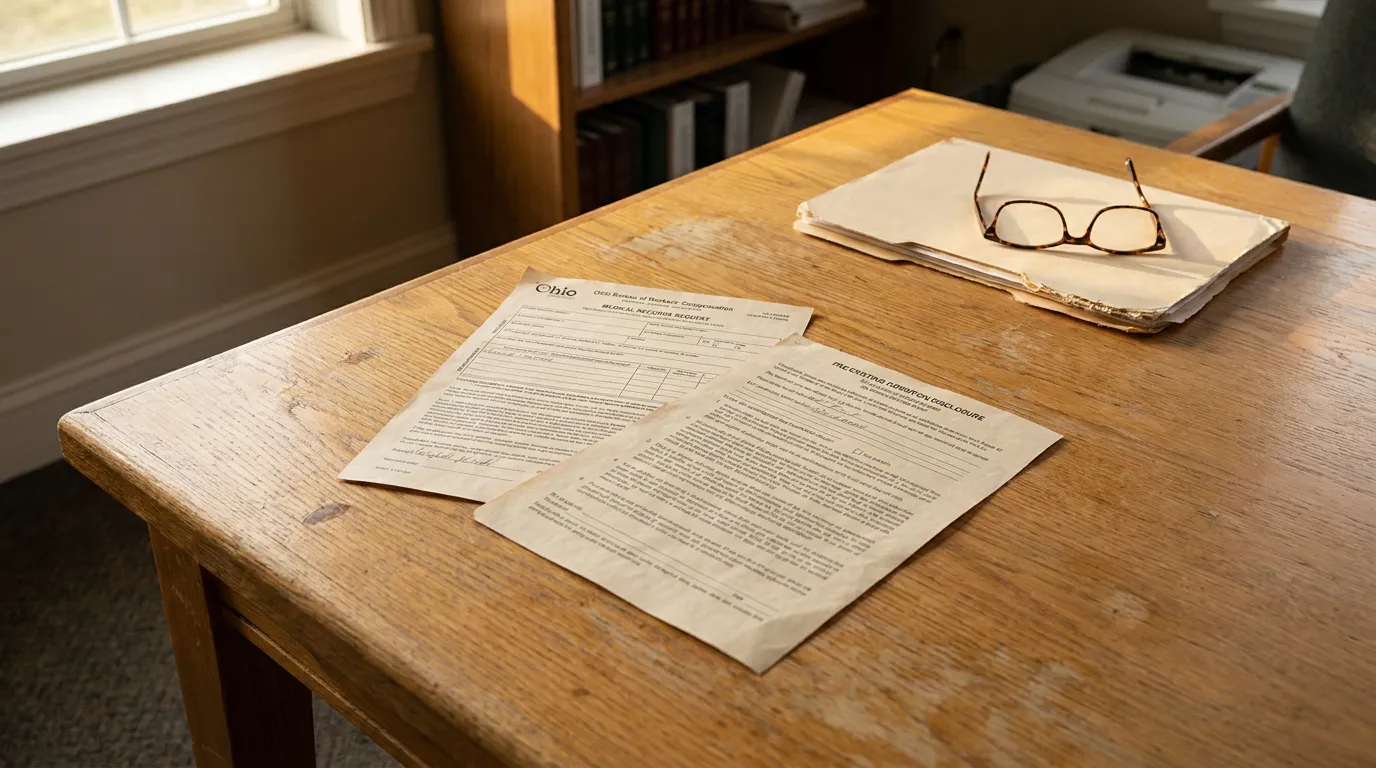
The Substantial Aggravation Definition Ohio Workers Need to Know
Ohio’s substantial aggravation standard sits between two extremes: a brand-new injury and a condition that simply got worse on its own. A compensable aggravation requires proof that the work event substantially worsened the pre-existing condition, not merely that it became more symptomatic afterward. Under R.C. § 4123.01(C)(4), that change must be documented by objective evidence such as imaging studies, range-of-motion measurements, nerve conduction testing, or comparative examination findings. The statute applies to injuries occurring on or after August 25, 2006.
The statute contains a limitation that surprises many injured workers. Once the aggravated condition returns to a level that would have existed without the injury, compensation and benefits for that allowed aggravation are no longer payable, even if the underlying condition continues to cause problems. That determination is a medical question decided on the evidence in your file, which is why documenting your condition before and after the incident matters.
Ohio remains a no-fault workers’ compensation system. You generally don’t need to prove your employer did anything wrong, and having a pre-existing condition doesn’t disqualify you. The question is medical causation, not blame.
Why Pre-Existing Conditions Complicate an Ohio Workers’ Comp Aggravation Claim
Pre-existing conditions create genuine analytical difficulty for claims administrators and hearing officers. They make it harder to determine which party should be liable, how much of a worker’s total disability a specific injury caused, and what benefits the worker is entitled to receive. Those three questions frequently drive the entire dispute in an aggravation case.
Liability can shift depending on where the pre-existing condition originated. Educational material on aggravation and pre-existing conditions explains that responsibility may differ depending on whether the condition arose in the worker’s personal life, during employment with a prior employer, or with the current employer. The relationship runs in two directions: a work injury can aggravate a pre-existing condition, and a pre-existing condition can aggravate a work injury. Ohio resolves these allocation issues through the objective-evidence standard in R.C. § 4123.01(C)(4) rather than through apportionment among employers.
Objective proof is the common thread across jurisdictions. Some states expressly require aggravation to be established through objective medical evidence such as expert opinion, treatment records, and diagnostic testing, because a worker’s own description of symptoms is too subjective to stand alone. Ohio’s statutory language reflects that philosophy.
Conditions That Commonly Get Aggravated at Work
Long-lasting health problems are extremely common among working adults. A chronic health condition is persistent or otherwise long-lasting in its effects, the opposite of an acute illness of short duration.
In Ohio workplaces, the conditions most often at issue in aggravation claims include:
- Degenerative disc disease and pre-existing spinal stenosis
- Osteoarthritis of the knee, hip, or shoulder
- Prior rotator cuff or meniscus tears
- Earlier surgical repairs, including fusions and joint replacements
- Prior injuries from a car crash, sports, or an old claim
How the Eggshell Skull Rule Relates to Ohio Workers’ Comp
The doctrine from personal injury law offers helpful background, though it’s not the controlling standard in a BWC claim. Under the thin skull doctrine, a defendant is liable for the full extent of a plaintiff’s unforeseeable reactions to a negligent or intentional tort. The principle is often summarized as taking the victim as you find them.
Ohio’s workers’ compensation statute is narrower. Because workers’ compensation is a no-fault statutory system rather than a tort remedy, R.C. § 4123.01(C)(4) compensates only the documented substantial worsening, measured against baseline, and only when supported by objective diagnostic findings, objective clinical findings, or objective test results. Understanding that distinction helps set realistic expectations.
Proving Substantial Aggravation Pre-Existing Condition Ohio Claims Require
Documentation wins these cases far more often than argument does. Because the statute demands objective evidence, the strongest ohio workers comp aggravation claim files usually contain before-and-after proof. Prior imaging showing a stable condition, followed by post-injury imaging showing a new herniation, larger tear, or measurable structural change, tends to be persuasive to hearing officers.
| Evidence Type | Why It Matters |
|---|---|
| Prior medical records | Establishes the baseline condition before the work injury |
| Post-injury imaging (MRI, CT, X-ray) | Shows objective structural change attributable to the event |
| Physician narrative report | Connects the work event to the documented worsening |
| Functional testing | Documents measurable loss of strength or motion |
| Treatment history | Demonstrates the condition was stable or controlled before |
Employers and administrators frequently argue that the worsening is simply natural progression of an existing disease. That defense is common, which is why a treating physician’s causation opinion should address progression directly, stating the opinion to a reasonable degree of medical probability. Academic analysis published in an Ohio law review article discusses these doctrinal tensions in the Ohio system.
💡 Pro Tip: Ask your treating physician whether any imaging exists from before your injury. Even a decade-old X-ray from an unrelated visit can become the baseline comparison that supports your claim.
What to Do After a Workplace Injury Worsened Your Condition
Report the incident promptly and describe it accurately, including your history. Some workers hide a prior condition fearing it will disqualify them. That approach often backfires, because the omission is later used to challenge credibility. Honest disclosure paired with clear evidence of worsening is generally the stronger path.
Timing matters procedurally. For injuries occurring on or after September 29, 2017, R.C. § 4123.84 generally requires that a claim be filed within one year; a two-year period applies to earlier injuries. Occupational disease claims follow different timeframes under R.C. § 4123.85. Limited exceptions exist, but these deadlines are jurisdictional and strictly applied.
Practical steps that strengthen an ohio BWC aggravation claim include:
- Seeking medical care immediately and describing the work event to every provider
- Requesting copies of your own prior medical records early
- Asking that the aggravation be specifically listed among the allowed conditions
- Keeping a dated record of new limitations and symptoms
- Responding promptly to any independent medical examination notice
💡 Pro Tip: Pay close attention to the exact conditions listed on your claim allowance. Benefits generally flow only for allowed conditions, so an unlisted aggravation may go uncompensated even when the claim itself is approved.
When Denials Happen and What Comes Next
Denials in aggravation cases are common, and a denial is not the end of the process. Ohio’s system allows appeals through the Industrial Commission, where hearing officers review medical evidence and testimony. Appeals from a BWC order must generally be filed within 14 days of receipt. Additional or updated medical opinions submitted at the right stage can change the outcome, and certain decisions may later be appealed to common pleas court under R.C. § 4123.512.
A Dayton work injury lawyer can help identify what the file is missing. Frequently the gap is not a lack of merit but a lack of the right objective documentation or a physician report that doesn’t address the statutory elements. Reviewing more workers’ compensation legal insights can help you understand the process before your hearing.
Frequently Asked Questions
1. Does a pre-existing condition automatically disqualify my Ohio claim?
No. Ohio is a no-fault system, and pre-existing conditions are extremely common. Under R.C. § 4123.01(C)(4), the question is whether objective findings document a substantial worsening caused by the work event.
2. What counts as objective evidence of aggravation?
Imaging studies, objective clinical examination findings, diagnostic test results, and measurable functional changes. Under the statute, your description of increased pain alone is insufficient.
3. Can my aggravation benefits end even if I still hurt?
Potentially, yes. If medical evidence shows the condition has returned to the level that would have existed without the injury, compensation tied to the allowed aggravation is no longer payable.
4. What if I never told my employer about my prior condition?
Disclose it now to your treating providers and in your claim documentation. Concealment damages credibility far more than the pre-existing condition damages the claim.
5. How long do I have to file an aggravation claim in Ohio?
For injuries on or after September 29, 2017, claims generally must be filed within one year under R.C. § 4123.84, with a two-year period for earlier injuries and separate rules for occupational diseases. Exceptions are limited, so acting quickly is advisable.
Protecting Your Claim When History Complicates the Medicine
Substantial aggravation claims are winnable, but they are evidence-driven. Ohio law doesn’t punish workers for having a medical history, yet R.C. § 4123.01(C)(4) requires objective proof that the job substantially worsened the condition and a baseline against which that worsening can be measured. Outcomes depend heavily on the specific medical records, physician opinions, and timing involved in each case.
If your Dayton workers compensation claim was denied or limited because of a pre-existing condition, Horenstein Nicholson & Blumenthal is ready to review your file. Reach a substantial aggravation pre-existing condition ohio lawyer by calling (937) 224-7200, or schedule your case review today to get started.
Related Posts

What Is an MCS-90 Endorsement in a Dayton Truck Accident Claim?
How the MCS-90 Endorsement Truck Accident Protection Actually Works The endorsement is a promise made to the public, not just to the insured carrier. Under 49 CFR 387.15, the insurer agrees to pay any final judgment recovered against the insured for public liability arising from negligent operation of motor vehicles, up to the applicable minimum limit. Because the obligation runs to the public, courts have held…
READ MORE
What Is the No-Zone Around Trucks in Dayton, Ohio?
Understanding the Hidden Danger of Truck Blind Spots on Dayton Roads Key Takeaways: The no-zone is the set of blind spot areas at the front, back, and both sides of a large truck where a smaller vehicle disappears from the driver’s view, creating a core hazard on Dayton roads like I-75 and U.S. 35. The right side is the largest blind spot and the rear leaves…
READ MOREWhat Is a Hit and Run Injury Claim Under Ohio Law for Dayton Victims?
Understanding Your Rights After a Hit-Skip Crash in the Miami Valley Key Takeaways: A hit and run injury claim under Ohio law allows Dayton victims to seek compensation after a driver flees, primarily through their own uninsured motorist (UM) coverage, since Ohio treats a fleeing driver like an uninsured one. Recovery remains possible even when the driver is never identified, provided independent corroborating evidence such as…
READ MORE
Should Dayton Drivers Move a Car After a Minor Ohio Collision?
The Short Answer for Dayton Drivers Facing a Fender Bender Key Takeaways: Dayton drivers can move a car after a minor Ohio collision, but only after fulfilling their legal duties first. Ohio law requires you to stop immediately, remain at the scene, and exchange identifying information including name, address, and vehicle registration before repositioning any vehicle. Once you’ve met those duties and documented the original positions…
READ MORE
What Should Dayton Workers Weigh Before Accepting a Lump Sum Settlement?
Understanding Lump Sum Settlements in Ohio’s Workers’ Comp System Key Takeaways: Before accepting a lump sum settlement (LSS), Dayton workers should weigh immediate financial relief against long-term rights they may permanently give up. An LSS closes all or part of a claim for a one-time payment often discounted to present value. Either party can initiate a settlement under Ohio law, so an employer’s offer may reflect…
READ MORE
What Makes a Dayton Truck Accident Case Harder to Prove Than a Car Crash?
Why Trucking Claims Demand a Different Playbook Than Ordinary Crashes Key Takeaways: A Dayton truck accident case is harder to prove than a car crash because liability can be spread across multiple parties, the driver, carrier, maintenance provider, and cargo loaders, each with separate insurance and defense counsel. Evidence is more technical, requiring driver logs, hours-of-service data, maintenance records, and black box downloads held by trucking…
READ MORE
How to Protect a Dayton Car Accident Claim From Adjuster Tactics
Why Dayton Drivers Lose Value on Otherwise Strong Claims Key Takeaways: Insurance adjusters minimize payouts using predictable tactics like delays, lowball offers, recorded statements, and inflated fault arguments. To protect a Dayton car accident claim, know what to do after a crash in Ohio before signing anything or giving a statement. Document the scene, seek prompt medical care, and preserve all evidence. Understand Ohio’s modified comparative…
READ MOREGet HNB to Help You
What our client has to say

Laurie Ruscillo
in Google Reviews
“During a very difficult time, there was compassion and a truly dedicated effort from the staff for a favorable outcome with a disability claim from the Social Security Administration.”
Related Posts
What Is an MCS-90 Endorsement in a Dayton Truck Accident Claim?
How the MCS-90 Endorsement Truck Accident Protection Actually Works The endorsement is a promise made to the public, not just to the insured carrier. Under 49 CFR 387.15, the insurer agrees to pay any final judgment recovered against the insured for public liability arising from negligent operation of motor vehicles, up to the applicable minimum limit. Because the obligation runs to the public, courts have held…
READ MORE What Is the No-Zone Around Trucks in Dayton, Ohio?
Understanding the Hidden Danger of Truck Blind Spots on Dayton Roads Key Takeaways: The no-zone is the set of blind spot areas at the front, back, and both sides of a large truck where a smaller vehicle disappears from the driver’s view, creating a core hazard on Dayton roads like I-75 and U.S. 35. The right side is the largest blind spot and the rear leaves…
READ MOREWhat Is a Hit and Run Injury Claim Under Ohio Law for Dayton Victims?
Understanding Your Rights After a Hit-Skip Crash in the Miami Valley Key Takeaways: A hit and run injury claim under Ohio law allows Dayton victims to seek compensation after a driver flees, primarily through their own uninsured motorist (UM) coverage, since Ohio treats a fleeing driver like an uninsured one. Recovery remains possible even when the driver is never identified, provided independent corroborating evidence such as…
READ MORE Should Dayton Drivers Move a Car After a Minor Ohio Collision?
The Short Answer for Dayton Drivers Facing a Fender Bender Key Takeaways: Dayton drivers can move a car after a minor Ohio collision, but only after fulfilling their legal duties first. Ohio law requires you to stop immediately, remain at the scene, and exchange identifying information including name, address, and vehicle registration before repositioning any vehicle. Once you’ve met those duties and documented the original positions…
READ MORE What Should Dayton Workers Weigh Before Accepting a Lump Sum Settlement?
Understanding Lump Sum Settlements in Ohio’s Workers’ Comp System Key Takeaways: Before accepting a lump sum settlement (LSS), Dayton workers should weigh immediate financial relief against long-term rights they may permanently give up. An LSS closes all or part of a claim for a one-time payment often discounted to present value. Either party can initiate a settlement under Ohio law, so an employer’s offer may reflect…
READ MORE What Makes a Dayton Truck Accident Case Harder to Prove Than a Car Crash?
Why Trucking Claims Demand a Different Playbook Than Ordinary Crashes Key Takeaways: A Dayton truck accident case is harder to prove than a car crash because liability can be spread across multiple parties, the driver, carrier, maintenance provider, and cargo loaders, each with separate insurance and defense counsel. Evidence is more technical, requiring driver logs, hours-of-service data, maintenance records, and black box downloads held by trucking…
READ MORE How to Protect a Dayton Car Accident Claim From Adjuster Tactics
Why Dayton Drivers Lose Value on Otherwise Strong Claims Key Takeaways: Insurance adjusters minimize payouts using predictable tactics like delays, lowball offers, recorded statements, and inflated fault arguments. To protect a Dayton car accident claim, know what to do after a crash in Ohio before signing anything or giving a statement. Document the scene, seek prompt medical care, and preserve all evidence. Understand Ohio’s modified comparative…
READ MORE


Phone

Hours
AVAILABLE 24/7
OFFICES
Dayton, OH
220 E. Monument Ave.
Suite 305
Dayton, OH 45402